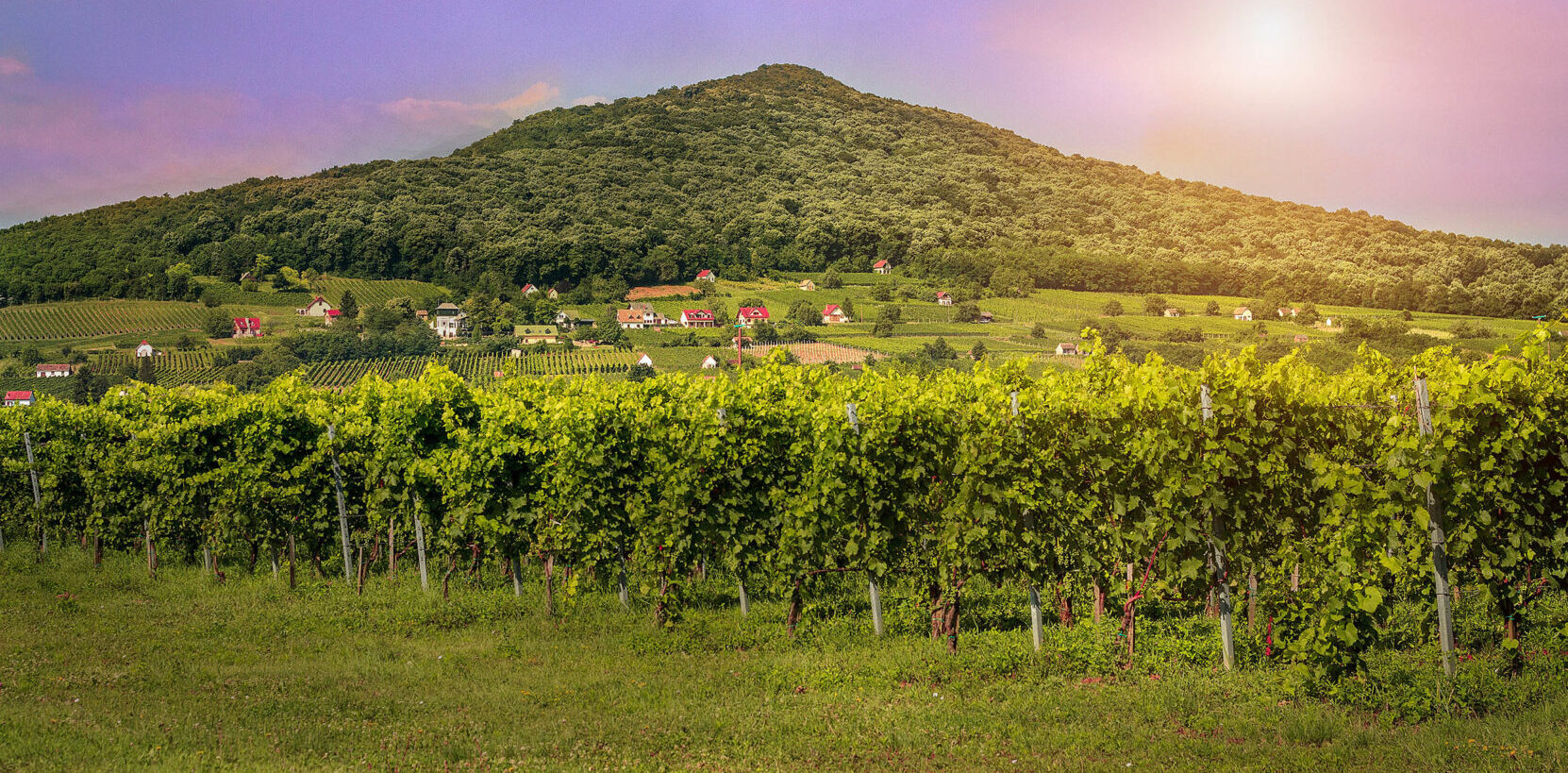
"In order to express its terroir, wine requires considerably less than most winemakers believe they can afford." Horst Hummel
The wine region
Villány is situated in the south-west of Hungary about 30 km south of Pécs and has sub-mediterranean climate. The wine region has the reputation of the leading red wine area in Hungary. In the western part of the area arround Siklos, also high-quality white wines have been produced for centuries benefitting from soils with higher limestone content.
The wine region has a loess layer up to 25 m thick, with a high limestone and mineral content. Remarkable is the high mag-nesium content, which is responsible for their typical mild animating bitterness in the Villány terroir wines.
Red wines get produced from the grapes of Blue Portuguese, Kékfrankos (Lemberger, Blaufränkisch), Cabernet Sauvignon, Cabernet Franc, Merlot, Pinot Noir, Kadarka and Syrah.
White wines from the varieties Olaszrizling, Hárslevelu, Királyleanyka, Gewürztraminer, Chardonnay, Sauvignon Blanc and a very small quantity of Furmint.
The soils are formed by sediments of the Pannonian Sea. The vineyards are situated on hills facing south, south-east and south west, that origin from geological elevations. Since the political turn of 1989, the wine-growing region has experienced a renaissance as one of the great European red wine terroirs.
''Villany has a unique terroir, comparable to no other European or non European wine region''
Villány is located on the border between Mediterranean and continental climate (sub-Mediterranean climate). The winters can be very cold and precipitous, but depending on the climatic course of the very year they are strongly moderated by the variying Mediterranean influence. The summers are predominantly hot and dry and, for their part, mitigated by the year-to-year varying Mediterranean climate. Already in August, the tropical nights in June and July often drop below 20° C.
One can say that in Villány the dry (extreme) continental heat and cold and the moist (mild) balanced Mediterranean coolness and warmth meet and influence each other. Depending on the climatic course of the very year, the climatic extremes are differently pronounced. This particular feature explains the different characteristics of the Villányi vintages.
The Villány Terroir is characterized by its double protection against cold winds from the north, which is given by the Mecsek mountains and the Tenkes mountain range (Villányi Hegység). The Villány vineyards benefit from this privileged situation. It allows the full ripening of late-ripening varieties such as Cabernet Sauvignon and offers early-ripening varieties such as Blue Portuguese the opportunity to fully develop their potential.
The Villány soil, the terroir in the closer sense, is calcareous, mineral loess with a unique high magnesium content, which is responsible for a fine, animating bitterness in the Villány terroir wines. The soil is "cold" and has a high water keeping capacity. That is to say, the soil absorbs heat, but, in contrast to stony soils, gravel or slate, reflects little of it. The Vilányi soil is responsible for the high minerality, the fine structure and the strong body of Villányi terroir wines.
Crucial for the Villányi Terroir are on the one hand the extremes of the continental climate and on the other hand their play with the mitigating Mediterranean influence. Hot summers meet cold winters, hot summer days meet cool August nights, hot sun meets cool ground, and this clash of extremes is continuasly alleviated by the influence of the Mediterranean climate. The interplay of these characteristics with the Villányi grape varieties is the Villányi Terroir. In the Villányi wine, they become a lively, tensious, harmonious unity. The heat of the summer is reflected in the ripe fruit, the coolness of the soil and the August nights get expressed in the clear fruit aromas, the lime in the living acid, the minerality of the soils in the clear structure and animating bitterness of the wines and the nutritious loess in a well-shaped body.
Depending on which climat situation gets expressed in the very year, the individual aspects of the very climate situation get differently expressed in the Villányi grape varieties, which gives the Villány vintages an extraordinary diversity. The play of the unique Villányi climate with the Villányi soil and the Villányi grape varieties - the Villányi Terroir - gives the Villányi wines their independent character, its extraordinary complexity and its outstanding quality.
Nestled in northeastern Hungary, the Tokaj wine region is one of the most celebrated and historically significant wine-producing areas in the world. Recognised as a UNESCO World Heritage Site, Tokaj’s unique terroir — the combination of soil, climate, topography, and human influence — plays a central role in producing wines of exceptional character, most famously the legendary Tokaji Aszú, a sweet wine revered for centuries.
Climate and Geography
Tokaj lies at the confluence of the Tisza and Bodrog rivers, which contribute significantly to the region’s distinctive microclimate. The climate is continental with hot summers and cold winters, but it is the long, warm autumns with misty mornings that are crucial for the development of Botrytis cinerea or "noble rot." This beneficial fungus concentrates sugars and acids in the grapes, laying the foundation for Tokaji’s famed sweet wines.
The fog that rises from the rivers during the fall encourages the perfect conditions for botrytis to form. Afternoons often remain dry and sunny, which helps shrivel and preserve the infected grapes — a delicate balance that few regions in the world can consistently achieve.
Soil Composition,
Tokaj’s volcanic soils are among its most defining features. The region is characterised by a diverse mix of tuff, rhyolite, and andesite rocks, often interlaced with clay, loess, and limestone. These soils retain heat, promote good drainage, and impart a distinct mineral character to the wines. The volcanic bedrock is porous, allowing roots to penetrate deeply in search of nutrients, while also regulating vine stress — an essential factor in producing complex, concentrated grapes.
Each vineyard site or "dűlő" in Tokaj offers subtle variations in soil and exposure, and these differences are increasingly being celebrated in single-vineyard bottlings, which highlight the nuanced expression of terroir.
Grape Varieties
The Tokaj region is planted predominantly with native white grape varieties that are especially well-suited to the terroir. The most important are:
Furmint: The backbone of Tokaj wines, known for its high acidity and ability to express both mineral and fruity notes. It performs exceptionally in volcanic soils and ages well.
Hárslevelű: Aromatic and rich, it contributes floral and honeyed notes to blends.
Sárgamuskotály (Yellow Muscat): Adds perfumed aromas and a touch of exotic character.
Together, these grapes respond distinctly to the region’s terroir and are often blended to create wines of balance, elegance, and depth.
Human Influence and Tradition
Viticulture in Tokaj dates back over 1,000 years, and the region has long been associated with meticulous hand-harvesting and traditional winemaking techniques, including the aging of wines in cool, humid underground cellars carved into volcanic rock. These cellars maintain consistent conditions year-round and are often coated with a noble mould that helps regulate humidity.
The concept of terroir in Tokaj is not just about nature — it is deeply intertwined with the history, knowledge, and dedication of the local winegrowers.